This article explains public information. It does not determine eligibility or replace an official notice.
What the land record portal shows
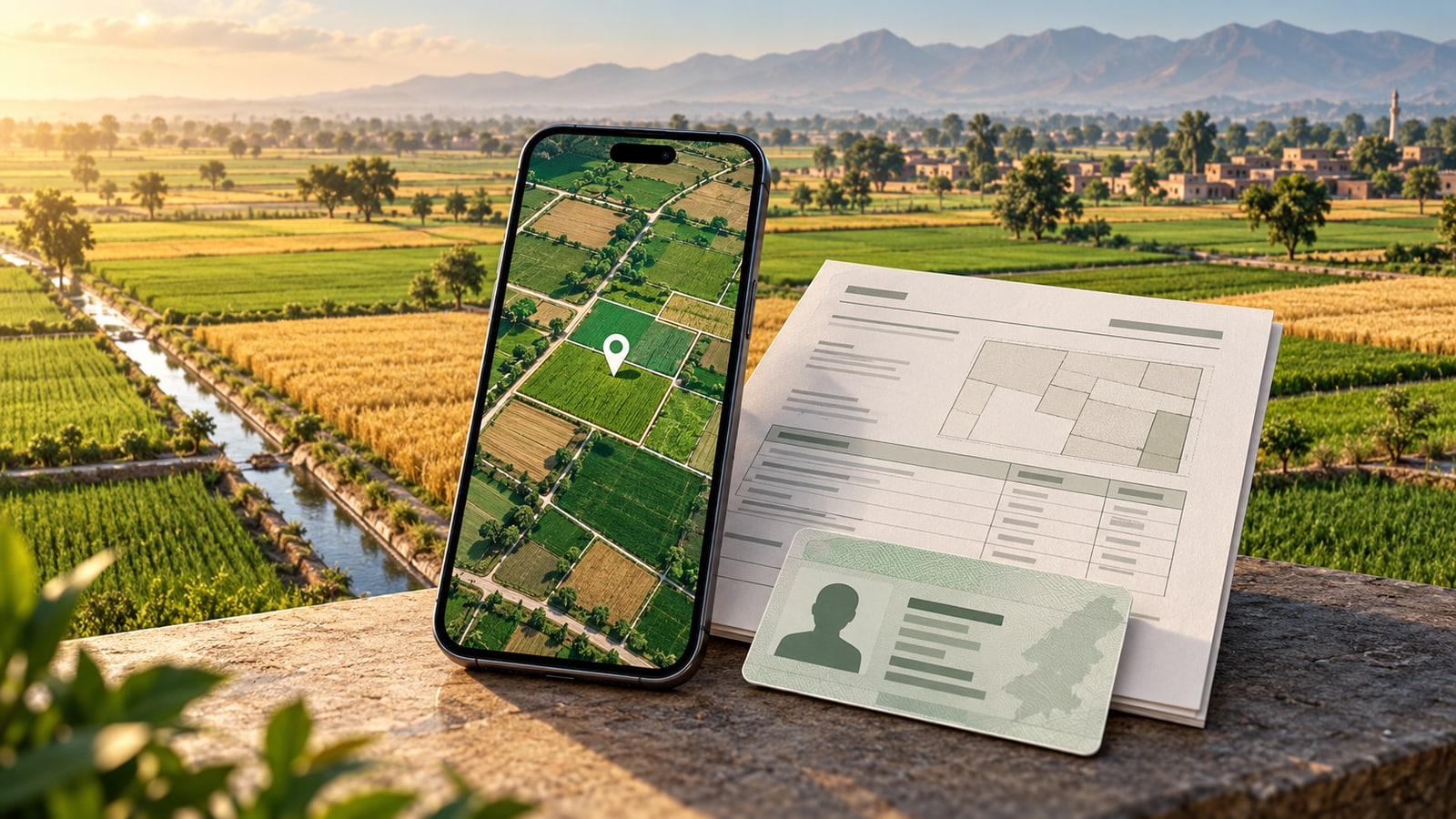
The PLRA land record portal provides an authenticated digital summary of the official revenue estate register, displaying the legal ownership breakdown and parcel parameters.
Key Property Identifiers: Khewat, Khatooni, and Khasra Numbers
Every land parcel in Punjab is indexed through three core revenue numbers:
- **Khewat Number:** Identifies the joint-ownership account within a specific Mauza (revenue village).
- **Khatooni Number:** Documents the tenancy holding, identifying who cultivates the plot and under what terms.
- **Khasra Number:** Designates the specific physical survey plot number on the revenue cadastral map (*Aksi Shajra*).
Recorded Ownership Shares, Area Measurements, and Land Classification
The portal breaks down ownership entitlement and physical parameters:
- **Ownership Share (*Hissa*):** Shows the total Khewat land alongside your exact fractional entitlement (e.g., 12/80 share).
- **Land Dimensions:** Measured in standard Kanals and Marlas (1 Kanal equals 20 Marlas, standardizing at 5,445 sq ft in rural revenue estates).
- **Land Classification:** Identifies agricultural soil type (Nehri, Chahi, Barani) or residential use (*Ghair Mumkin Abadi*).
Encumbrance, Mortgage, and Mutation (Intiqal) Status
The system reflects any active legal restrictions on the land:
- **Mortgages (*Rahn*):** Shows active bank liens or agricultural credit charges.
- **Court Stays:** Flags pending civil litigation or injunctive court orders.
- **Mutation (*Intiqal*):** Details completed or pending property transfers from sales, gifts, or inheritance.
Who is eligible for jamabandi
Any citizen, buyer, or institution with a legitimate legal interest can check Jamabandi records on the PLRA portal.
- **Registered Title Holders:** Landowners verifying that their computerized land records and CNICs are accurately integrated.
- **Legal Heirs:** Family members checking ancestral holdings and family pedigree trees (*Shajra Nasb*) during inheritance distribution.
- **Property Buyers:** Real estate investors conducting due diligence to verify genuine title, clear shares, and lack of encumbrances before executing purchase contracts.
- **Financial Institutions:** Commercial banks evaluating property collateral for business loans or programs like Apni Chhat Apna Ghar.
How to check your record by CNIC
- **Access the Official Portal:** Navigate to the official PLRA website () or launch the Punjab Zameen App on Android or iOS.
- **Select Administrative Location:** Select your **District**, **Tehsil**, and **Mauza** (revenue village) from the cascading dropdown menus.
- **Select CNIC Search Mode:** Choose the **Search by CNIC** filter on the query panel.
- **Enter 13-Digit CNIC:** Input your 13-digit National Identity Card number without hyphens or spaces.
- **Solve Security Captcha:** Enter the alphanumeric security captcha shown on the screen and click **Search Record**.
- **Review and Download Jamabandi:** Inspect the on-screen ownership summary, Khewat share, and Khasra numbers, or save the digital record as a PDF.
Jamabandi, Fard and Girdawari explained
Landowners frequently confuse the primary documents of the Punjab revenue administration.
What is Jamabandi?
Jamabandi is the foundational ownership ledger of a revenue estate. Prepared under Section 41 of the *Punjab Land Revenue Act 1967*, it lists all title holders, tenancy terms, and land assessments within the village.
What is a Fard?
A Fard is an authenticated certificate extracted from the Jamabandi database. For legal sales or bank loans, you must obtain a certified Fard containing an official 16-digit Fard ID and QR code from an Arazi Record Center (ARC) or the e-Fard portal.
What is Khasra Girdawari?
Khasra Girdawari tracks physical occupation and agriculture on the ground. The Patwari visits the fields biannually to document who is cultivating the soil (*Kashtkar*) and which crops are growing, distinguishing physical possession from registered title.
| Feature | Jamabandi | Fard (Fard-e-Malkiat) | Khasra Girdawari |
|---|---|---|---|
| Legal Nature | Master Register of Rights (*Register Haqdaaran-e-Zameen*) | Certified extract or official copy of the Jamabandi | Seasonal harvest and crop inspection register |
| Primary Function | Permanent record of title, joint shares, and revenue assessments | Official proof of title required for sale deeds, bank loans, and court bail | Documents actual physical possession (*Qabza*) and standing crops |
| Update Cycle | Revised every four years (Quadrennial Register) | Issued on-demand with real-time digital validity | Conducted twice yearly during Rabi and Kharif harvest seasons |
| Issuing Source | PLRA centralized database / Revenue Department | Arazi Record Centers, authorized banks, or PLRA e-portal | On-site inspection by Field Patwari, verified by Qanungo |
| Key Information | Khewat, Khatooni, Khasra, co-owners, gross area | Owner name, specific share, barcode, Fard ID, security QR code | Plot number, cultivating tenant (*Kashtkar*), crop variety, yield |
| Legal Value | Presumption of truth under Punjab Land Revenue Act 1967 | Statutorily required for deed registration and legal transactions | Primary evidence of actual physical possession in tenancy disputes |
Fees and timelines
Viewing your Jamabandi record online is free. Official certified documents issued for commercial or legal transactions require standard government fees.
Payment Channels and PSID Expiry
PLRA generates a 17-digit PSID payment challan for certified services. You can pay via 1-Bill mobile banking, ATM, branch counters (NBP and BOP), or JazzCash/EasyPaisa. Generated PSID challans remain valid for **30 calendar days**, after which unpaid requests expire automatically.
| Service / Document | Channel | Normal Fee | Express Fee | Issuance Time |
|---|---|---|---|---|
| Online Jamabandi View | PLRA Website / App | Free | N/A | Instant |
| Official Fard (Record / Title) | ARC / e-Fard Portal | PKR 900 | PKR 4,000 | 15–30 Mins (ARC) / 24–48 Hrs (Online) |
| Official Fard for Sale Deed | Arazi Record Center | PKR 900 | PKR 4,000 | Same Day (Biometric required) |
| Mutation (*Intiqal*) | ARC / Revenue Office | PKR 1,200 | PKR 11,200 | 3 to 15 Working Days |
| e-Registration Charges | Sub-Registrar Portal | 0.1% of DC Value | N/A | Variable by District Schedule |
Common errors and fixes
System bottlenecks or legacy data gaps can trigger online search failures.
"Record Not Found" by CNIC (Legacy Manual Record Issue)
Older land titles inherited before 2012 were recorded under handwritten manual registers using the owner's name and father's name without a CNIC number. When PLRA computerized these records, unmapped profiles could not be retrieved solely by identity numbers. If your CNIC displays zero records, switch your search method to Mauza and Khewat number or Owner Name. Once located, file an official identity integration request at your local ARC to link your 13-digit CNIC permanently.
Name Spelling and Father's Name Mismatches in Urdu
Urdu names often have varied spelling conventions (e.g., Muhammad with or without shaddah, or variations in Khan/Begum). A single typo prevents exact match queries. To resolve this, search using property numbers rather than text strings. Once the property is displayed, verify whether the recorded father's name or caste matches your family tree. If an error exists, file a formal correction petition under Section 40 of the Punjab Land Revenue Act.
Pending Mutations (Intiqal) and System Delays
If you recently bought land or inherited property but the Jamabandi does not reflect your ownership, the mutation (*Intiqal*) may still be in the "Under Process" stage. A registered deed (*Baye-Nama*) does not automatically transfer revenue title; it requires a Patwari report, Field Qanungo verification, and formal sanction by the Revenue Officer. You can track mutation progress through the Track Mutation tab on the PLRA portal using your mutation token number.
| Issue Encountered | Underlying Cause | Corrective Action |
|---|---|---|
| "Record Not Found" by CNIC | CNIC is not integrated into legacy manual revenue books | Search by Mauza and Khewat number or owner name, then visit an ARC with your CNIC and sale deed to link your record. |
| Spelling Errors in Urdu Names | Data entry typos during initial computerization | Query the database by Khasra or Khewat number. Submit a correction request (*Durasti Record*) via the ARC. |
| Pending Mutation Not Shown | Property transfer deed is awaiting Revenue Officer sanction | Check your status using the Track Mutation portal tab using your application token. |
| Server Timeout / 504 Error | High portal server load during peak hours (11 AM – 3 PM) | Clear your browser cache and access the portal during off-peak windows (8:00 AM – 10:00 AM or after 7:00 PM). |
| Biometric Mismatch at ARC | Worn fingerprints failing NADRA threshold validation | Obtain a NADRA biometric certificate or request manual verification signed by the Assistant Commissioner. |
Frequently asked questions
Can I check Punjab land records online using only my CNIC?
Yes, you can check land records online by CNIC, but you must first select the District, Tehsil, and Mauza where the property is located. The PLRA database indexes records by revenue estate, requiring geographic filtering before CNIC matching.
Is viewing land records online on the PLRA portal free?
Viewing your digital Jamabandi summary online is entirely free of cost. Fees apply only when applying for an official certified Fard or filing a property mutation through an Arazi Record Center or the e-Fard system.
What is the fee for an official Fard in Punjab in 2026?
The official PLRA fee for a certified Fard is PKR 900 for normal service. For urgent issuance, the express counter fee is PKR 4,000.
What is the main difference between Jamabandi and Fard?
Jamabandi is the master village register detailing all ownership titles, while a Fard is an official certified extract issued from that register for legal or commercial use.
Why does the portal show "Record Not Found" for my CNIC?
This occurs when an older ancestral title has not had its 13-digit CNIC mapped into the computerized revenue system. Locate the property using your Khewat number or name, then visit an Arazi Record Center to link your CNIC.
How do I check the status of a pending land mutation (Intiqal) online?
Visit punjab-zameen.gov.pk, open the Track Mutation tab, select your District and Tehsil, and enter your 13-digit CNIC or Mutation Token Number to view the approval stage.
Can an overseas Pakistani check land records remotely?
Yes, overseas Pakistanis can access the PLRA portal or Punjab Zameen App internationally using their NICOP or CNIC number. PLRA also provides dedicated overseas facilitation desks in selected Pakistani foreign missions.
What is Khasra Girdawari and how is it different from Jamabandi?
Khasra Girdawari is a biannual field inspection register documenting standing crops and physical possession, whereas Jamabandi records permanent legal ownership rights.
How long is a PLRA PSID challan valid?
A PLRA PSID payment challan remains valid for 30 calendar days from the date of issuance. If unpaid within 30 days, the challan expires and must be regenerated.
Is an online printed Jamabandi valid for property sales or court bail?
An online informational printout is not legally valid for executing sales or court bail. Formal legal proceedings require an official certified Fard carrying a registered Fard ID, security barcode, and PLRA stamp.
Sources and official links
Check the destination address before entering personal information.
Muhammad Salman specializes in Pakistani public sector financing, youth entrepreneurship schemes, and government subsidy programmes, cross-referencing all data against official SBP circulars and ministry directives.
Related guides
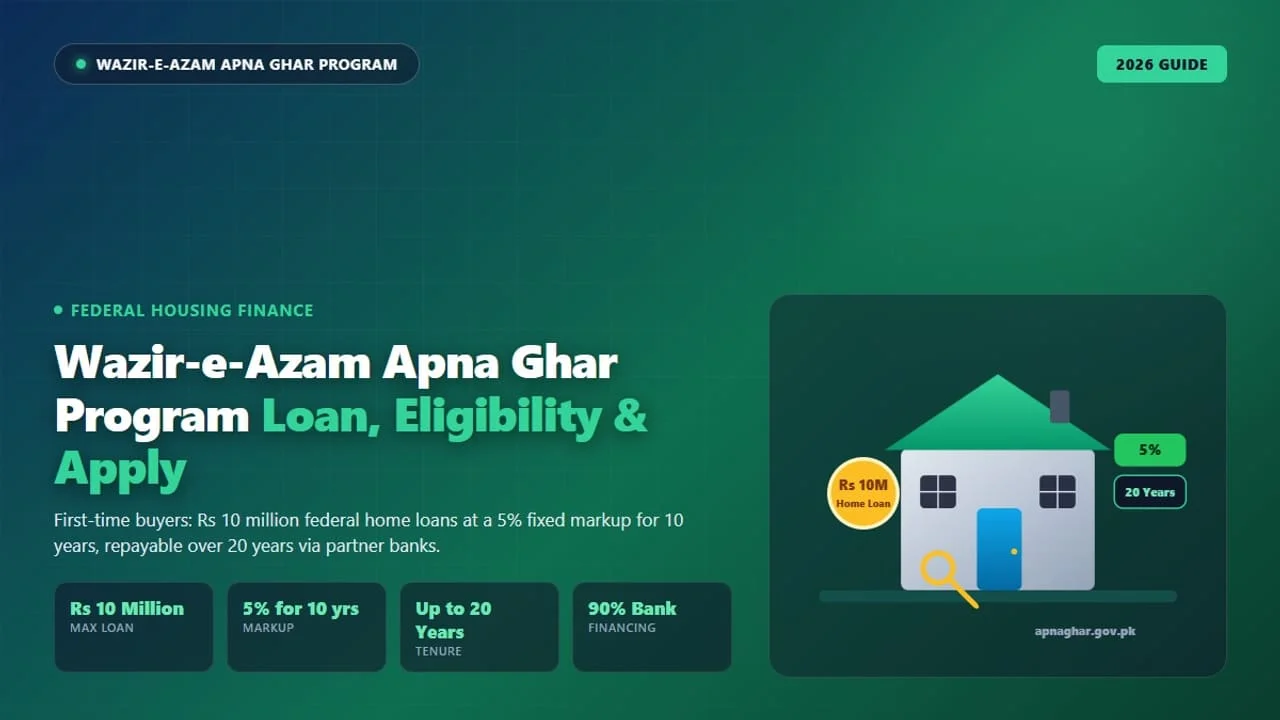
Wazir-e-Azam Apna Ghar Program 2026: Loan, Eligibility & How to Apply
The Wazir-e-Azam Apna Ghar Program (Ghar Ho Tu Apna) gives first-time buyers federal home loans up to Rs 10 million at a 5% fixed markup for the first 10 years, repayable over 20 years through partner banks. Apply online at apnaghar.gov.pk.
Read guide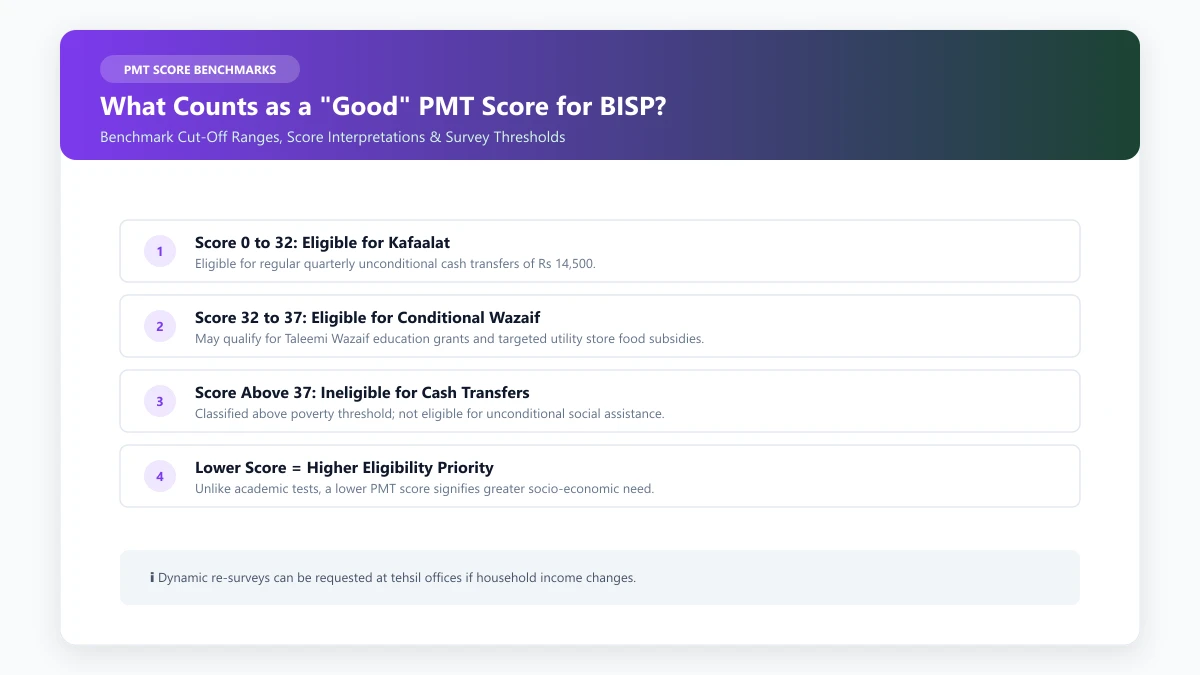
What Counts as a "Good" PMT Score for BISP?
A good PMT score for BISP is 32 or below on the Proxy Means Test scale. See the relaxed 37 cut-off, what each score band means, and how to check your household record by CNIC on 8171.
Read guide